Trading involves understanding the gap between two prices. The bid price is what a buyer will pay for an asset. The ask price is what a seller wants to receive. This difference is called a spread. Spreads show up in every market type. Traders encounter them in forex, stocks, indices, and commodities.
Every trader pays spreads when buying and selling assets. These costs eat into profits over time. Brokers use spreads as a way to make money. UK traders need to understand how spreads work to calculate real trading costs.
A spread trading guide should cover multiple types of spreads. Raw spreads are the tightest spreads available. Trading costs UK vary based on market conditions and broker choice. Forex spread trading shows how these costs apply to currency pairs.
This guide walks through the complete picture of spreads in UK financial markets. It explains raw spreads and how they differ from standard spreads. The guide shows real examples from forex, indices, and commodity markets. Traders learn how spreads impact their bottom line.
Understanding spreads is the first step to profitable trading. Whether a trader uses a standard account or raw spread account, spreads will affect every trade. This resource covers everything needed to make smart decisions about spread costs.
What Is Spread in Finance?
For a deeper breakdown of definitions and real-world examples, read our detailed guide on Spread Finance Definition: Types and Real Market Examples.
A spread definition in finance refers to the difference between two prices in a financial market. The most common type traders encounter is the bid-ask spread, which represents the gap between what buyers are willing to pay and what sellers are asking for an asset. Understanding this concept is essential for anyone trading in forex, stocks, or commodities.
The bid-ask spread works like this: the bid price is what traders can sell an asset for, while the ask price is what they must pay to buy it. This difference creates an immediate cost when entering a trade. For example, if EUR/USD is quoted at 1.1000 bid and 1.1002 ask, the spread equals 2 pips. Traders start in a slightly negative position equal to the spread size the moment they enter a position.
- Major forex pairs typically offer the tightest spreads due to high trading volume
- Exotic currency pairs present wider spreads reflecting lower liquidity
- Small-cap stocks show larger spreads than blue-chip stocks
- Niche commodities display wider spreads than popular trading instruments
Recognizing how spreads function helps traders calculate break-even points accurately. The narrower the spread definition for an asset, the less traders need to risk to cover trading costs. This makes understanding the bid-ask spread crucial for determining potential profitability before executing any position.
What Is Spread Trading?

If you’re new to the concept, our beginner-friendly article What Is Spread Trading? Meaning, Examples and Risks explains it step by step.
Spread trading differs from simply understanding spreads as trading costs. This strategy involves taking simultaneous positions in two related financial instruments to profit from the price difference between them. Rather than betting on whether a single market will rise or fall, spread traders focus on the relative performance between two correlated assets.
The core principle of spread trading strategies centers on capturing gains from price movements in the relationship between paired instruments. For example, UK traders might trade the price difference between Brent crude oil and WTI crude oil, or between equity indices like the FTSE 100 and the DAX 40. This approach reduces directional market risk because gains in one position can offset losses in the other, creating a more balanced and hedged trading approach.
- Correlation relationships between paired assets
- Relative value analysis and historical price patterns
- Factors that cause spreads to widen or narrow
- Market conditions and economic data affecting both instruments
Common applications of spread trading strategies include:
- Calendar spreads – trading the same asset at different expiration dates
- Inter-commodity spreads – related commodities with price dependencies
- Pairs trading – correlated stocks or indices moving in tandem
Arbitrage trading represents a specialized form where traders exploit temporary price inefficiencies between simultaneous positions. This approach appeals to traders seeking lower-risk alternatives compared to outright directional positions, making it an attractive strategy for those wanting to reduce exposure to overall market movements.
Types of Spreads in Financial Markets
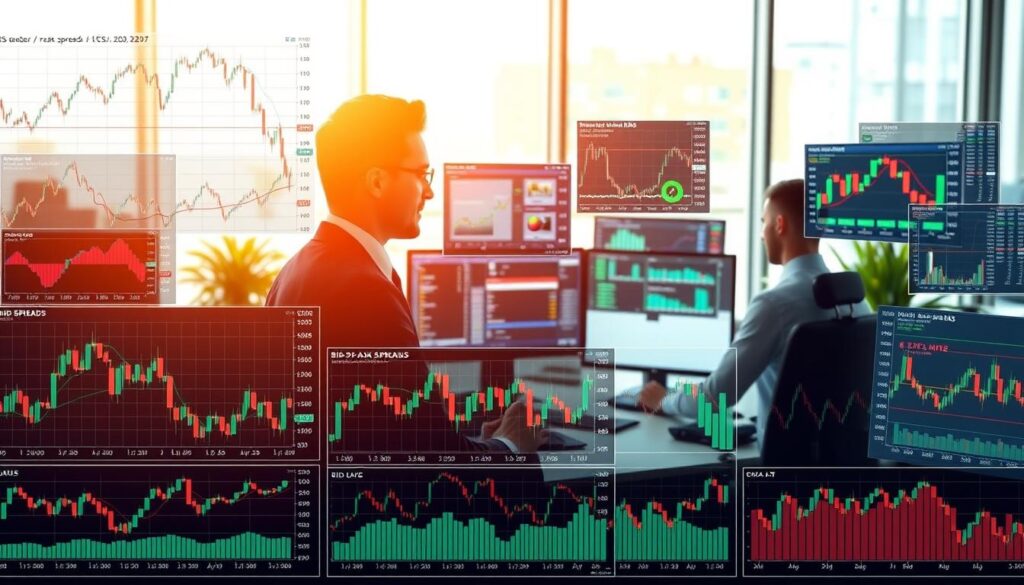
Learn how brokers calculate pricing in our full explanation of Raw Spread Meaning in Forex: How Brokers Really Price Trades.
Financial markets feature several types of spreads that traders encounter daily. Understanding these different categories helps traders calculate costs and make better trading decisions. Each type of spread serves a specific purpose in how brokers and market maker spreads operate. Traders must learn about each category to grasp the true cost of their trades.
Bid-Ask Spread
The bid-ask spread represents the most fundamental type of spread in trading. The bid price is what traders can sell an asset for, while the ask price is what they pay to buy it. The difference between these two prices creates the spread. When a trader opens a position, they start with a small loss equal to this spread amount.
For the market to break even, prices must move in the trader’s favor by at least the spread size. A bid-ask spread calculation shows real costs. For example, if a trader buys EUR/USD at 1.1002 and immediately sells at 1.1000, they lose 2 pips right away.
Bid-ask spreads reflect market liquidity. Tighter spreads indicate deep, liquid markets with many buyers and sellers. Wider spreads signal thinner markets with fewer participants. Trading volume, volatility, time of day, and broker pricing models all influence spread width.
Raw Spread
Raw spreads offer traders the most transparent pricing available. These spreads show the true market difference without broker markup. Brokers passing raw spreads to clients charge a commission instead of hiding costs within wider spreads.
- Raw spreads fluctuate constantly with market conditions
- Traders see actual interbank pricing
- Commission fees apply separately
Fixed Spread
Fixed spreads remain constant regardless of market conditions. Brokers guarantee these spread widths during normal trading hours. This predictability helps traders plan trades with known entry and exit costs.
Variable spreads, by contrast, expand and contract with market volatility. Fixed spreads work best during stable market periods but may become less competitive during high-volatility events.
Futures Spread
Futures spreads involve trading the price difference between two different futures contracts. Traders might buy one contract month and sell another simultaneously. This strategy lets traders profit from the relationship between contracts rather than betting on direction alone. Futures spreads typically carry lower costs than standard position trading.
Raw Spread vs Standard Account
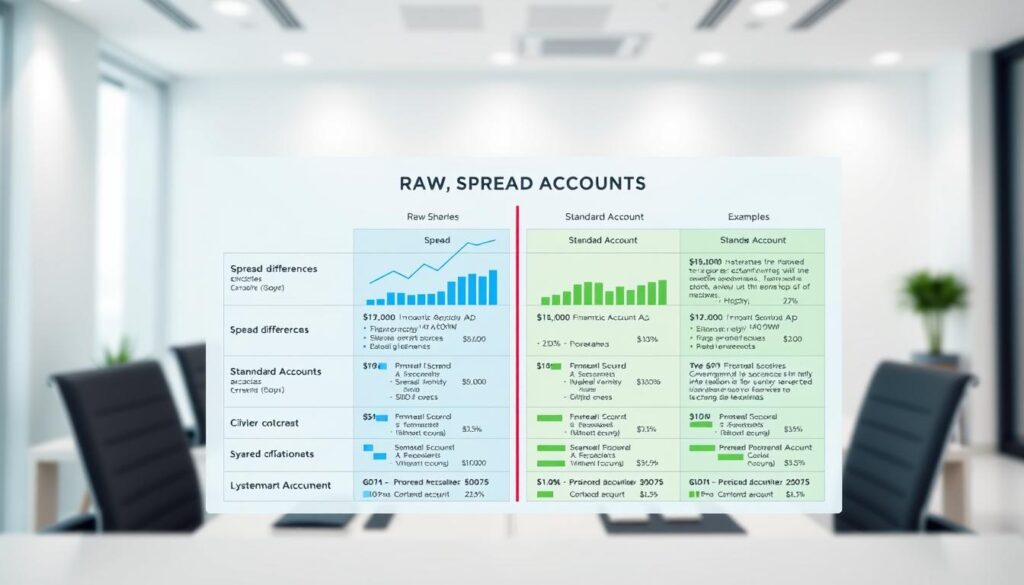
See a detailed side-by-side cost comparison in Raw Spread vs Standard Account: Cost Comparison With Examples.
Traders in the United Kingdom face an important choice when selecting a trading account. Understanding the difference between raw spread accounts and standard accounts helps traders pick the right option for their needs. Each account type uses a different pricing model that affects overall trading costs.
A standard account bundles all broker fees into wider spreads. Brokers do not charge a separate commission vs spread structure. Instead, they widen the bid-ask gap to cover their costs and profits. On EUR/USD currency pairs, standard spreads typically range from 1.0 to 2.0 pips. This approach keeps cost calculations simple for new traders.
Raw spread accounts operate differently. These raw spread accounts provide direct access to interbank pricing with spreads as low as 0.0 to 0.2 pips. Brokers charge a fixed commission instead. Traders pay roughly £5 to £8 per lot for round-turn trades. This commission vs spread model benefits active traders who execute many trades monthly.
A practical standard account comparison shows the real-world impact. A trader executing 100 lots monthly on EUR/USD pays £1,500 with standard accounts (1.5-pip spreads). The same activity on raw spread accounts costs only £800 (0.2-pip spreads plus £6 commission). This represents nearly 50% in savings.
- Standard accounts suit beginner traders who make fewer trades
- Raw spread accounts work best for scalpers and day traders
- Break-even occurs around 10 to 20 trades monthly
- Professional traders prefer raw spread accounts for transparency
Traders should evaluate their monthly trade frequency before choosing. Those executing under 20 trades monthly benefit from standard account simplicity. Active traders gain significant savings with raw spread accounts.
How Brokers Make Money From Spreads

Brokers earn revenue through different business models that shape how traders pay for their services. Understanding these broker revenue models helps traders recognize where costs come from and whether a broker’s incentives align with their trading success.
The spread itself represents the broker’s main source of income. When traders open positions, brokers pocket the difference between the bid and ask prices. This gap is the most direct way brokers generate revenue from every trade executed on their platforms.
Market Maker Profits and Fixed Spreads
Market maker brokers create their own prices based on liquidity provider feeds. They add a markup to both bid and ask prices, and this markup represents their profit on each trade. For example, if institutional pricing shows EUR/USD at 1.1000/1.1001, a market maker might quote clients 1.0999/1.1002, keeping the 2-pip difference as revenue.
Market maker profits come directly from spread markups. These brokers often offer fixed spreads, which provide consistency but at slightly higher levels than raw institutional pricing.
ECN Broker Commissions and Variable Spreads
ECN broker commissions work differently. These brokers pass through raw institutional pricing without adding a markup. Instead, they charge transparent commissions per trade. This model offers variable spreads that can be very tight under normal market conditions.
- ECN brokers earn regardless of client trading outcomes
- Commissions replace spread markups as the revenue source
- Spreads fluctuate based on market liquidity
Additional Revenue Sources
Brokers also generate income through swap fees on overnight positions, inactivity charges, currency conversion costs, and payment processing fees. FCA-regulated brokers in the United Kingdom maintain ethical practices and transparent pricing structures regardless of their chosen revenue model.
Spread Trading Strategies

For more advanced techniques, read Financial Spread Trading: How Professionals Use It.
Spread trading strategies help UK traders capture profits from price differences between related assets. These approaches work across forex, indices, commodities, and stock markets. Understanding different spread trading techniques allows traders to find opportunities in various market conditions.
One popular method involves pairs trading, where traders identify two assets that move together historically. For example, a trader might watch BP and Shell stocks or GBP/USD and EUR/USD currency pairs. When these instruments move apart from their normal relationship, pairs trading profits from them returning to their typical pattern. This strategy works best when traders understand what normally happens with these price relationships.
Mean reversion trading assumes that spreads between related assets will return to average levels over time. When spreads widen unusually, traders expect them to narrow again. This approach requires patience and solid data about historical spread patterns.
Calendar spread strategy focuses on futures and options markets. Traders exploit price differences between near-term and longer-dated contracts for the same asset. These spreads often reflect storage costs, interest rates, and market expectations about future prices.
Statistical arbitrage uses mathematical models to find trading opportunities based on historical price relationships. This technique identifies when prices stray from normal patterns and predicts they will return to expected levels.
- Inter-commodity spreads like the crack spread (crude oil versus refined products)
- Index spreads between FTSE 100 and FTSE 250 stocks
- Grain spreads comparing corn and wheat prices
Risk management matters greatly for spread traders. Monitor how assets move together, size positions properly on both sides, and set stop-losses based on spread movement rather than absolute price changes. Success requires analytical tools, understanding market fundamentals, and discipline when spreads move against positions temporarily.
Real Examples of Spread Trading

Understanding spread trading becomes much clearer when examining real market situations. Traders gain practical knowledge by studying actual currency pairs, indices, and commodities. These concrete spread trading examples show how costs impact profit potential and why timing matters in active trading.
Live market spreads change throughout the day based on liquidity and trading activity. Studying these real-world scenarios helps traders make better decisions about when to enter and exit positions. The following examples demonstrate practical spread calculations across different asset classes.
Forex Spread Trading Examples
Forex spread examples reveal how quickly costs add up during trading. Consider the EUR/USD pair, one of the most liquid currency pairs available. When EUR/USD is quoted at 1.1000 bid and 1.1002 ask, the spread equals 2 pips—the immediate cost to open a trade.
Currency pair spreads vary based on market conditions. During busy London trading hours, EUR/USD typically shows spreads of 0.2 to 0.8 pips. During slower Asian trading sessions, these same currency pair spreads might widen to 1 to 2 pips.
A trader buying EUR/USD at 1.1002 needs the price to rise above this level just to break even. A favorable 10-pip move yields only 8 pips net profit after subtracting the 2-pip spread cost. Here’s how practical spread calculations affect different scenarios:
- GBP/USD spreads typically range from 0.5 to 1.2 pips during peak hours
- USD/JPY spreads average 0.3 to 0.9 pips in liquid conditions
- Exotic pairs show spreads of 15 to 50 pips during normal trading
Scalping strategies demonstrate how spreads directly impact profitability. A trader executing 20 trades daily targeting 5-pip profits with 0.5-pip spreads nets 90 pips total. The same strategy with 2-pip spreads nets only 60 pips—a significant 33 percent reduction in earnings.
Index Spread Trading Examples
Index trading involves different spread dynamics than forex markets. Major indices like the FTSE 100, DAX, and S&P 500 show tighter live market spreads during peak trading sessions. These spreads widen considerably during off-peak hours when fewer traders participate.
Index spreads typically range from 1 to 3 points on major indices during active trading. The FTSE 100 might show a 2-point spread during London opening hours, narrowing to 1 point during the session’s busiest periods. Understanding these timing patterns helps traders optimize their entry points.
Commodity Spread Trading Examples
Commodity markets display unique spread characteristics depending on the underlying asset. Crude oil spreads typically range from 1 to 3 cents per barrel during high-volume trading. Gold spreads remain relatively tight, usually between 0.5 to 2 dollars per ounce during standard market hours.
Agricultural commodities show wider spreads than precious metals or energy products. Wheat and corn spreads can fluctuate between 5 to 15 cents per bushel based on seasonal trading volume and market news.
These spread trading examples across all asset classes illustrate a fundamental principle: traders benefit significantly from trading during peak liquidity periods. Practical spread calculations reveal that even small improvements in spread costs translate into substantial long-term profit differences for active trading strategies.
Risks of Spread Trading

Spread trading brings unique challenges that traders need to understand before entering the market. The main spread trading risks involve several key factors that can turn profitable strategies into losses. Understanding these dangers helps traders protect their capital and make smarter decisions.
One of the biggest concerns is spread widening risk. During major news releases or volatile market conditions, spreads can expand dramatically. For example, the EUR/USD pair normally trades at 0.5 pips. During important economic announcements like Bank of England interest rate decisions or US Non-Farm Payrolls, spreads can jump to 5-10 pips or wider. This sudden change increases trading costs significantly and can trigger wider stop-losses than planned.
Another critical risk is liquidity risk. When trading during overnight hours or with less popular instruments, finding buyers and sellers becomes difficult. Low liquidity creates wider spreads and makes it harder to exit positions quickly. Traders may face substantial losses if they cannot close trades at expected prices.
For traders using spread strategies like pairs trading, correlation breakdown presents a serious threat. This happens when two instruments that normally move together suddenly diverge. When correlation breaks down, both legs of the trade can lose money instead of hedging each other, defeating the strategy’s purpose.
Traders should take these steps to manage spread trading risks:
- Avoid trading during major news events unless planning for volatility
- Check real-time spreads before entering any position
- Use limit orders to control execution prices
- Keep enough account capital to handle temporary spread movements
- Monitor market liquidity before trading less popular instruments
Slippage is another indirect cost that occurs when trades execute at different prices than expected. Fast-moving markets and low liquidity cause slippage to increase substantially. Leverage amplifies these risks, turning small spread movements into larger losses.
Is Spread Trading Good for Beginners?

Understanding spreads matters for every trader starting their journey. Spreads represent the gap between buying and selling prices. This gap is an immediate cost that must be overcome before profits can be made. New traders in the UK should grasp this concept before moving into more complex trading approaches.
Spread trading for beginners works best when they start with the right account structure. Fixed spread accounts offer predictable costs without surprises. This clarity helps new traders plan their trades with confidence and understand exactly how much they will pay to enter and exit positions.
Learning spread trading requires a step-by-step approach. Beginners should follow this progression:
- Master single-instrument trading first while paying attention to spread costs
- Compare spreads across different brokers and account types
- Practice with demo accounts to understand how trades work
- Only then explore advanced spread trading strategies
Beginner trading strategies that involve actual spread trading pairs require more knowledge. These include correlation analysis, multi-leg order execution, and sophisticated risk management. New traders should gain foundational experience before attempting these approaches.
Spread-only accounts suit beginners well because they eliminate commission complexity. Smaller spreads mean lower costs, which improves profit potential. This benefit applies especially to traders who make frequent trades.
Learning spread trading also teaches valuable lessons about market psychology. Spread strategies typically create lower volatility and reduced directional exposure compared to outright positions. This stability helps new traders stay calm during market swings.
- Start with small position sizes to limit learning losses
- Use demo accounts extensively before risking real money
- Study how different markets correlate with each other
- Track your spread costs in every trade
Spread awareness is mandatory for all traders. Spread trading strategies themselves work best after gaining real market experience and developing analytical skills.
Final Thoughts
Understanding spreads and trading costs is vital for anyone serious about trading in UK financial markets. These costs might look tiny on each trade. Yet they add up fast across dozens or hundreds of trades. Smart traders know that managing costs is just as important as finding good entry points. By learning how spreads work and which fees apply, traders can make better choices and avoid losing money to hidden charges.
Choosing spread accounts requires careful thought about your trading style. Standard accounts with fixed spreads work well for traders who do not trade often. Raw spread accounts with commissions suit traders who make many trades each month. UK-regulated brokers like Interactive Brokers and CMC Markets offer transparent pricing that helps traders know exactly what they pay. When optimizing trading costs, look beyond just the spread itself. Consider overnight fees, currency conversion charges, and how well your broker executes trades at the prices shown.
The spread trading conclusion matters for long-term success. Traders who track their total costs as a percent of their account find ways to cut expenses. This might mean trading at times when spreads are tighter or switching to a broker with lower fees. The traders who win over many years treat cost control as a real part of their plan. Your profit depends not just on where the market goes. It depends on how much you keep from each winning trade after all costs are paid.
Take time to audit your monthly expenses with your current broker. Calculate what you pay in spreads and commissions as a share of your gains. Use this data to pick the right account type and broker for your needs. FCA-regulated firms in the UK offer the safety and price honesty that matter most. By making smart choices about spread accounts and optimizing trading costs today, traders build the solid habits needed for profitable trading tomorrow.