IC Markets Raw Spread vs Standard Account: Full Comparison With Real Examples
Founded in Australia in 2007, this globally regulated broker specializes in forex and CFD trading. It provides access to a vast selection of over 1,980 financial instruments. These include major currency pairs, popular commodities, and key indices.
This guide offers a detailed examination for active traders in the United Kingdom. It explores the core differences between two primary account structures. Understanding these options is essential for optimizing your strategy and managing long-term costs.
The choice between a commission-based pricing model and a traditional spread-inclusive plan directly impacts your overall expenses. Each framework caters to different styles, from rapid scalping to longer-term position holding. We will break down the specific fee details using practical, real-world examples.
Selecting the correct account can significantly influence your profitability in the forex market. This analysis aims to equip you with the knowledge to make an informed decision tailored to your personal methodology.
Introduction to IC Markets Trading Accounts
Beginning its journey in Sydney over a decade ago, the broker now serves a vast international community of active traders. This global reach means clients from the United Kingdom and beyond can access its services. The firm caters to a diverse range of individuals, from newcomers to seasoned professionals.
Background and Global Reach
Since its start in Australia, the company has expanded its presence across major financial centers. It built a reputation for providing sophisticated solutions to a worldwide audience. This expansion ensures traders benefit from robust infrastructure and deep liquidity pools.
The environment is designed for those engaged in currency and CFD trading. A commitment to transparency and security is a cornerstone of its operations.
Platform Accessibility and Client Support
Users receive professional assistance 24 hours a day, seven days a week. This support covers everything from platform navigation to technical queries. Help is always available, regardless of a client’s location or experience level.
The broker supplements this with extensive educational materials and live webinars. These resources support ongoing skill development for all account holders. This focus on client growth helps traders navigate various global markets with more confidence.
Overview of Raw Spread and Standard Account Features
Active traders have a clear choice between two distinct pricing models when opening an account. This decision shapes their entire cost profile and approach to the financial markets.
Distinct Pricing Models
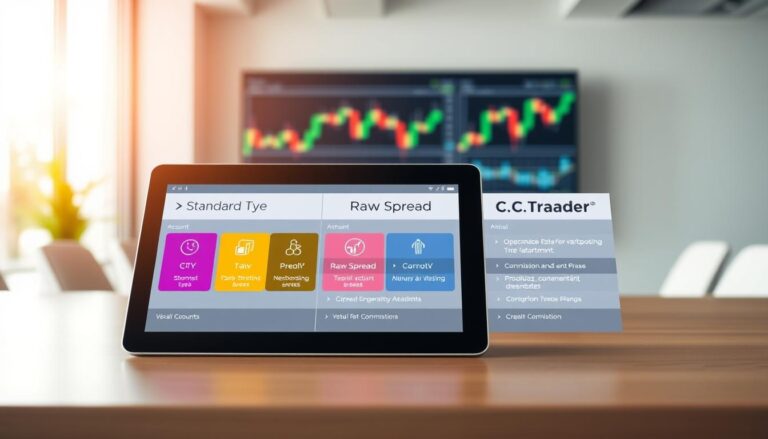
The raw spread account uses a commission-based model. It appeals to those seeking direct, institutional pricing for their daily trading. This setup offers maximum transparency on every transaction cost.
Conversely, the standard account bundles costs into a wider spread. This simplified structure is often easier for newcomers to understand. It removes the need to calculate separate commission fees on each trade.
Account Type Structure and Access
Both account types unlock the same vast selection of over 1,980 instruments. Traders can diversify across currencies, stocks, and commodities without limitation.
Users are not locked into a single choice. They can operate multiple accounts at once or switch as their strategy evolves. This flexibility supports a trader’s growth from beginner to expert.
The absence of a strict minimum deposit for some options lowers the initial barrier. It allows more people to participate in global financial markets confidently.
Comparing Trading Costs: Spreads and Commissions Explained

The core difference in trading expenses lies in how costs are structured for each account. One model separates the spread from a per-trade fee, while the other bundles everything together.
ECN Pricing and Real-Time Spreads
An ECN environment provides direct access to interbank liquidity. This setup aggregates prices from numerous top-tier institutions. Traders see the raw, real-time market spread, which can frequently hit 0.0 pips on major pairs.
This model uses a small commission fee per lot traded. The fee maintains access to this tight pricing. It offers full transparency, as every cost component is clearly itemized.
The alternative account type simplifies this for the user. All trading costs are incorporated into a single, wider spread quote. This approach is often preferred by those new to the markets.
Both setups draw from a deep pool of liquidity providers. This ensures competitive pricing and stable execution, even during volatile sessions. Your choice ultimately depends on your preference for cost clarity versus simplicity.
Tailoring Your Trading Strategy to Your Account Type

A trader’s methodology, from entry speed to holding period, should directly inform their choice between two primary pricing plans. This alignment is crucial for optimizing cost efficiency and execution ease in the financial markets.
Strategies for Scalpers and High-Frequency Traders
These participants require the lowest possible entry cost to profit from tiny, rapid price movements. The raw spread account model, with its ultra-tight margins, is designed for this precise need.
Algorithmic systems also thrive in this low-latency environment. The transparent fee per trade allows for precise calculation of strategy profitability.
Approaches for Beginners and Swing Traders
Newcomers and those holding positions for days or weeks often prioritize a simplified cost structure. The standard account bundles all fees into the quoted spread.
This removes the complexity of separate commission calculations. It provides a clearer view of total expenses for longer-term trades.
Successful trading requires adapting your risk management to your chosen platform’s fee model.
Understanding ic markets raw spread vs standard

A clear grasp of the core elements defining each pricing structure is vital for any participant. This understanding goes beyond simple cost comparisons. It delves into the fundamental mechanics of how fees are applied and services are delivered.
Key Components of Each Account Type
The primary difference in this raw spread standard comparison lies in the fee collection method. One plan charges a separate commission per trade. The other incorporates all costs directly into the displayed price quote.
This distinction shapes the entire user experience. The commission-based model is built for precision and cost transparency. The all-inclusive alternative prioritizes ease of use and simplicity for the operator.
Both plans provide identical access to the broker’s powerful technology and liquidity. Execution quality and platform reliability remain consistent, regardless of the chosen account type.
Individuals must evaluate their own activity level and capital size. High-frequency strategies often align with the raw spread standard model. Those with a longer-term focus may prefer the straightforward alternative.
Understanding these components allows for informed decisions. This knowledge directly impacts profitability and long-term success in the financial markets.
Analyzing Real Trading Examples and Costs
To move beyond theory, let’s apply the fee structures to a common currency pair. This practical view shows how expenses add up in real scenarios.
EUR/USD Cost Breakdown
Consider opening a position on the popular EUR/USD pair. The commission-based plan might display a spread as low as 0.1 pips.
A separate $7 round-turn commission applies per standard lot. This creates a fully transparent cost profile for every single trade.
The total expense is the sum of the spread cost and this fixed fee. The alternative plan bundles all costs into a single, wider price quote.
Cost Efficiency for High-Volume Trades
Frequent participants must examine long-term expense accumulation. The low-spread model shines here for active strategies.
Paying a small fee per lot often beats wider spreads over hundreds of trades. The savings from tight pricing can significantly outweigh the fixed commission.
This transparency allows for precise tracking of all trading costs. It is a vital tool for maintaining profitability in fast-paced financial markets.
By analyzing these real examples, operators can make a data-driven choice for their account. The right selection directly supports sustained success.
Platform and Execution: MT4, MT5, and Trading Technology

The technological backbone supporting a trader’s decisions is just as critical as the pricing model they select. Both primary account structures grant full access to the same powerful software suite. This ensures choice does not limit a user’s technical capabilities.
Reliable trading platforms and fast execution form the core of a positive experience. They allow strategies to be implemented as intended, without technical hindrance.
MetaTrader 4 and 5 Features Compared
The industry-standard MetaTrader platforms are available to all clients. MT4 remains the favorite for its simplicity and vast library of custom indicators. MT5 offers more advanced features, including additional timeframes and an economic calendar.
Both support automated trading via Expert Advisors and deep charting analysis. This flexibility caters to manual and algorithmic approaches across all financial markets.
Execution Speed and Reliability
Server infrastructure is hosted at the Equinix NY4 data center in New York. This strategic placement provides ultra-low latency connectivity to major liquidity hubs. Orders are processed in milliseconds, which is vital for fast-paced execution.
The system boasts a 99.98% uptime record and handles over 500,000 trades daily. This high reliability is essential during volatile market sessions. It gives traders confidence that their account activity will be processed smoothly.
Such robust technology supports all styles of trading, from scalping to long-term investing. Consistent platform performance is a key advantage for any serious participant.
Liquidity Providers and Market Execution

The quality of a broker’s market execution is fundamentally linked to its network of liquidity providers. These institutions form the backbone of price discovery and order filling. A robust network ensures traders receive competitive, real-time quotes for every transaction.
This broker aggregates pricing from up to 25 top-tier institutional liquidity providers. This creates deep market depth across all traded instruments. Such a wide pool helps maintain tight, raw pricing conditions for clients.
Market Depth and Transparent Pricing
Market execution means orders are filled at the best available price without intervention. It relies on real-time supply and demand data from the global marketplace. This model provides confidence that trades reflect true market conditions.
The use of multiple liquidity providers minimizes slippage and price impact. Even large orders can be executed efficiently. This is a key advantage for active participants in fast-paced trading environments.
Transparency is a hallmark of the ECN model. Traders can see the genuine depth of the markets at all times. This clear view supports informed decision-making for every account holder.
This institutional-grade approach benefits both primary account structures. It ensures consistent and fair pricing, whether one prefers commission-based or all-inclusive costs. The network of liquidity providers ultimately serves to enhance the overall trading experience.
Account Requirements and Leverage Opportunities
The initial capital requirement and the power of leverage are two critical factors that shape a trader’s entry into the markets. These elements determine both accessibility and potential scale from the very beginning.
Understanding these prerequisites helps participants plan their capital allocation effectively. It sets the foundation for a sustainable approach to the financial markets.
Minimum Deposits and Leverage Options
A minimum deposit of $200 applies to both primary account structures. This low barrier to entry makes professional platforms accessible to a wide audience.
Traders can then utilize leverage options that extend up to 1:500. This powerful tool allows control of larger positions with a smaller initial capital outlay.
However, higher leverage magnifies both gains and losses. Participants must adjust their settings according to personal risk tolerance and the volatility of their chosen instruments.
The flexibility to modify leverage within an account is a key feature. It enables tailored risk management strategies for different trading styles.
By maintaining an affordable minimum deposit, the broker encourages new entrants. They can gain hands-on experience with advanced trading tools without a prohibitive upfront cost.
This balance of accessibility and powerful options supports diverse account holders. From cautious beginners to aggressive strategists, each can configure their account to match their ambitions in the global markets.
The Role of Trading Infrastructure in Cost Efficiency
Beyond spreads and commissions, the underlying execution infrastructure plays a pivotal role in managing overall trading expenses. This technological backbone influences hidden costs like slippage and order delays.
Efficient systems benefit every account holder by ensuring prices and executions reflect true markets conditions.
Low-Latency Execution Environments
A broker’s investment in high-speed server networks is crucial. It ensures that markets raw execution speed remains consistent, even during volatile news releases.
This low-latency setup minimizes the price gaps that can occur between order placement and fill. Traders experience fewer unexpected costs from slippage.
Fast, reliable order processing supports all styles of trading. It allows strategies to be executed as intended, protecting account equity.
Impact of Institutional Liquidity Providers
A deep network of top-tier liquidity providers is the other half of the equation. These institutions supply the competitive prices and volume needed for tight spreads.
During major economic shifts, this network helps stabilize prices. It maintains the markets raw conditions that define a competitive edge.
The synergy between advanced technology and these liquidity providers creates a stable environment. Traders can operate with total confidence, knowing their account activity is supported by robust infrastructure.
This foundation is key for long-term success in global financial markets.
Balancing Simplicity and Precision in Account Selection
Achieving the right fit requires weighing the appeal of a simple, all-inclusive price against the granular precision of itemized fees. This balance is central to selecting the correct account structure.
Choosing between a spread account and a spread standard model defines this trade-off. One offers straightforward cost visibility. The other provides detailed breakdowns for maximum control.
Many traders value ease above all else. For them, the spread standard setup is the most effective path. It removes mental clutter from their daily routine.
Conversely, participants running rapid-fire strategies need pinpoint accuracy. They typically find a spread account with transparent fees indispensable. It allows for exact profit and loss calculations on every move.
A practical step is to test both options in a demo environment. This hands-on comparison reveals which fee structure feels more intuitive. It aligns the tool with the individual’s trading personality.
The best selection minimizes distraction from cost complexities. It lets the operator focus entirely on their methodology and the movements of the financial markets. This clarity is a powerful advantage for any account holder.
Ultimately, the goal is an account that supports, rather than hinders, your journey. Whether you prioritize simplicity or precision, the choice should empower your decisions in the global markets.
Final Takeaways for Your Trading Journey
The journey to successful trading is built on informed choices, starting with the selection of your account. This foundational decision directly shapes your cost structure and strategy. Active traders often favor the model with a commission for its tight pips and transparent fees.
Beginners may prefer the simplicity of an all-inclusive plan. Both account types provide identical access to powerful platforms, leverage, and currency pairs. You never compromise on execution quality or your trading experience.
We recommend every trader reviews their personal frequency and goals. Your chosen broker offers robust tools for forex CFD and forex pairs trading. Aligning your account type with your methodology is a powerful step toward mastery in the financial markets.