Spread vs Commission in Forex: Which Costs More?
Choosing a broker involves a critical decision about pricing models. Many active participants in the foreign exchange market must ask which fee structure impacts their bottom line more.
For individuals trading in the UK, grasping this difference is essential. It directly affects their ability to optimize expenses and enhance potential returns.
Brokers typically apply either a spread or a commission to generate revenue. These are the two primary methods for covering transaction costs and execution services.
However, they function in distinct ways. The final answer to which one costs more is not universal.
It depends heavily on several personal and market factors. These include how often one trades, the specific strategy employed, and the pairs being bought and sold.
This analysis will provide a clear breakdown. The goal is to help market participants select the model that best fits their financial goals and style.
The Fundamentals of Spread and Commission in Forex Trading
At the core of every currency transaction lie two fundamental cost components. These are the spread and the commission. They function in distinct ways but both directly influence a trader’s potential profit.
Defining Spread and Its Role in Forex Pricing
The spread is the difference between the bid (sell) price and the ask (buy) price. This gap represents a broker’s built-in fee for facilitating the trade.
Traders effectively pay a slightly higher price to enter a position. They also receive a slightly lower price when exiting. This mechanism is how the cost is applied.
Spreads come in two main types. A fixed spread remains constant, regardless of market volatility. A variable spread will widen or tighten with changing liquidity and conditions.
Understanding Commission Structures and Their Impact
A commission is a direct, separate fee charged per trade. It is often calculated as a fixed cost per lot or based on the total trade volume.
This model offers high transparency. The fee is clearly stated apart from the market price.
Many Electronic Communication Network (ECN) accounts use this structure. They typically feature very low, sometimes near-zero, spreads while applying an explicit commission. This creates a different cost profile for active participants.
spread vs commission forex: Key Differences in Trading Costs

A trader’s total expenses are shaped not just by the amount, but by the method of charging. The core distinction lies in how fees are applied and how visible they are to the account holder.
Understanding this is crucial for effective cost management in currency trading.
Payment Methods and Calculation Techniques
One model applies an indirect cost embedded within the buy and sell prices. This is measured in pips, representing the gap between these two figures.
The other uses a direct, separate deduction from the account. It is typically a fixed charge per lot traded.
This fundamental difference in application affects how participants calculate their break-even points from the outset.
Cost Transparency and Hidden Fees
Direct-fee accounts provide clear visibility into exact trading costs. The charge is listed separately on statements.
The indirect model can sometimes obscure the true expense. During volatile market periods, the embedded cost can widen unexpectedly.
This creates a potential for hidden fees that are not apparent in calm conditions. For professionals requiring predictability, this transparency difference is a major factor.
How Trading Strategies Influence Costs: From Scalping to Position Trading

Whether holding for minutes or months, a trader’s time horizon dictates which expenses matter most. A trading strategy fundamentally shapes cost sensitivity.
Short-Term Trading Considerations
Scalpers and day traders execute many trades within brief time frames. They target small profits from each move.
For this strategy, even minor spreads can erase gains. These traders often prefer ECN accounts.
Such accounts offer transparent, fixed commissions. This provides predictable costs during market volatility.
Longer-Term Trade Impacts and Swap Considerations
Swing and position traders hold positions for days or weeks. The distance between entry and exit points grows.
Spread costs become less significant over this extended time. However, swap fees emerge as a primary consideration.
These overnight interest charges accumulate on held positions. For longer-term approaches, account selection has more flexibility.
Account Types and Pricing Models in Forex Trading
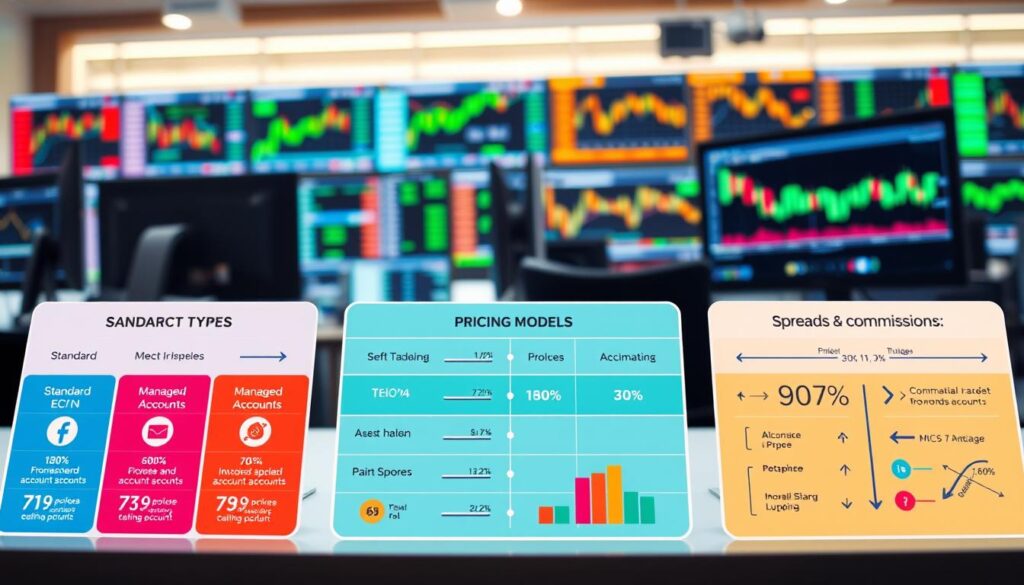
Brokers present traders with a primary choice between simplified, all-inclusive pricing and transparent, fee-based models. This decision is central to managing expenses effectively.
Spread-Only Accounts for Simplicity
These account types bundle all costs into the bid-ask difference. They are designed for simplicity and ease of use.
New market participants and those with a lower trading frequency often prefer them. There is no need to track separate fees.
The cost is automatically embedded in the price quote. This creates an all-inclusive structure for managing expenses.
Commission-Based Accounts for Transparency
Other account types separate execution fees from market pricing. They typically offer much tighter spreads, sometimes near zero.
A fixed, per-trade charge is then applied. This model provides high transparency and predictable costs.
Active participants, like scalpers, favor this structure. For example, some brokers offer accounts with a small fixed commission per lot.
This leads to lower cumulative expenses for frequent trading. The choice between these models should align with one’s strategy and preference for cost clarity.
The Role of Market Volatility and Liquidity in Cost Management

A key factor in expense management lies in how different account structures respond to fluctuating market environments. Predictable costs can become unstable when global financial conditions shift.
Market Conditions and Variable Spreads
During high volatility, like major news releases, variable spreads can widen significantly. For example, the EUR/USD pair might jump from 1.4 pips to over 3.0 pips. This instantly raises expenses for traders.
Market liquidity also changes throughout the day. The tightest conditions usually occur when London and New York sessions overlap. Participation and competition are highest then.
In contrast, low-liquidity periods see wider gaps. Late New York hours or before Sydney opens are typical examples. Reduced activity leads to less favorable pricing.
The fixed-fee model offers more stability here. While raw spreads may still move, the separate charge remains constant. This provides predictable cost management during turbulent times.
Many active participants prefer this transparency when markets are uncertain. It shields them from the full impact of sudden price gaps.
Reducing Trading Costs: Tips for UK Forex Traders

Smart traders know that reducing fees isn’t just about picking the cheapest advertised rate. It requires a holistic approach that combines careful broker selection with disciplined execution habits.
Selecting the Right Broker and Account Type
The first step is a thorough broker comparison. Look beyond the initial spread quotes.
Evaluate the firm’s regulatory standing, execution quality, and overall fee schedule. Many brokers offer specialized accounts like ECN or VIP tiers.
These often provide superior pricing for active participants. They feature tighter spreads and transparent, fixed commissions.
This choice directly impacts your long-term expense profile.
Effective Trading Strategies to Minimize Fees
Your trading strategy plays a crucial role. Focus on executing high-quality setups rather than numerous, low-probability trades.
This reduces the cumulative impact of fees over time. Also, time your activity during peak liquidity hours.
The London-New York session overlap typically offers the tightest conditions. Avoid entering the market during major news releases or extreme volatility.
Spreads can widen dramatically, raising costs regardless of your account type. A disciplined, patient approach is a powerful tool for cost management.
Evaluating Swap and Additional Fees in Forex Trading

An often-overlooked aspect of total trading expenses is the overnight interest adjustment. For positions held past the daily close, a separate cost layer applies.
Understanding Swap and Its Calculation
Swap refers to the interest paid or earned for holding a currency pair overnight. It is tied to the difference in central bank rates between the two currencies.
When a trader buys a currency with a higher interest rate, they may receive a credit. Holding a long EUR/USD position could yield a positive swap if the Euro rate is 1.5% and the Dollar rate is 0.5%.
Conversely, a short position on that pair typically incurs a debit. This fee is deducted from the account daily at the broker’s specified rollover time.
A key calendar event is Triple Swap Wednesday. To account for weekend interest, brokers charge three times the normal rate on Wednesdays.
For swing and position traders, these daily charges can accumulate significantly. Over weeks, the total may surpass the initial entry costs.
Evaluating swap rates is therefore essential for accurate profit calculation. It is a vital part of managing long-term strategy expenses.
Final Thoughts on Optimizing Forex Trading Costs
Ultimately, the path to cost efficiency is not a one-size-fits-all formula. The optimal fee structure depends entirely on a trader’s personal style and strategic objectives.
For those prioritizing simplicity and longer holding periods, a spread-based account often makes sense. On the other hand, active participants benefit from the transparency of a direct commission model.
Evaluating your own strategy—its frequency and time horizon—is the essential final step. This self-assessment, paired with selecting a reputable UK broker, allows you to align your costs with your goals for better trading outcomes.