XTB Currency Conversion Fees on Weekends and Holidays Explained
For active investors, every cost matters. A key expense to understand involves trading international assets. This happens when a security is listed in a different money than your account’s base funds.
The broker XTB applies a currency conversion fee for these transactions. On regular weekdays, this charge is 0.5%. However, the cost rises to 0.8% on weekends and public holidays.
This tiered pricing makes timing an important factor. The higher weekend fee reflects reduced activity in global forex markets. With lower liquidity, the cost for the broker to execute the exchange increases.
Understanding this fee structure helps traders make smarter decisions. They can plan trades to avoid unnecessary costs. This guide will explore how these fees work and strategies to manage them effectively.
Understanding XTB’s Platform and Fee Structure
Navigating investment platforms requires understanding both accessibility and cost structures from the outset. This broker has served clients globally since 2002, growing to manage substantial assets across diverse markets.
The platform offers two distinct approaches to market participation. Traditional investors benefit from commission-free stocks and ETFs through the Invest service. Active trading enthusiasts can access CFD instruments for more advanced strategies.
Opening an account involves no minimum deposit or maintenance charges. This removes significant barriers for newcomers to financial markets. The fee structure remains competitive, with zero commission applying to monthly volumes under €100,000.
Beyond this threshold, a modest 0.2% charge per transaction takes effect. The platform generates revenue through various services rather than basic account fees. This aligns the broker’s interests with client success in trading activities.
Navigating XTB Currency Conversion for Optimal Trading
https://www.youtube.com/watch?v=JuteesEoed0
The foundation of cost-effective international trading lies in proper account currency selection. This decision directly impacts total expenses when operating across different markets.
Traders with EUR-denominated accounts enjoy fee-free purchases of European stocks and ETFs. This makes the EUR option ideal for those focusing primarily on European markets.
Conversely, USD account holders benefit from zero conversion costs when buying American securities. However, they face bank fees when initially funding their accounts from non-dollar sources.
Strategic investors often align their account currency with their primary investment markets. This approach minimizes ongoing conversion-related expenses over the long term.
The platform displays all fees transparently before order confirmation. This allows for informed decisions about each transaction’s total cost structure.
Deep Dive into XTB Currency Conversion Fee Structure
The mechanics of cross-border investing involve more than just picking the right asset. A critical component is understanding the fee applied when the transaction’s denomination differs from your account’s base funds.
This broker employs a two-tiered pricing model. The standard rate of 0.5% is active on weekdays. This amount is applied to the total transaction value.
During weekends and public holidays, the cost rises to 0.8%. This increase reflects the higher costs brokers face when global forex markets have lower liquidity. Timing trades for weekdays can save investors 0.3% on this expense.
It is vital to consider the total amount being exchanged. A larger trade value means a proportionally higher fee. This makes cost awareness essential for effective position sizing.
How does this structure compare to other options?
- Traditional Banks: Often charge 2-3% for similar services.
- Specialised Forex Brokers: May offer slightly lower rates.
- XTB’s Transparency: The charge is shown clearly before you confirm any trade.
For frequent international traders, these costs can add up over time. Factoring them into profit calculations is a key step for long-term success.
Impacts of Currency Conversion Costs on Trading

Portfolio returns face gradual erosion from seemingly minor transaction expenses. For active market participants, these costs accumulate significantly over time.
Consider a trader making monthly €500 investments in US securities from a EUR-denominated account. Each transaction incurs a small charge that totals €30 annually. Over several years, this recurring expense compounds substantially.
Strategic investors often concentrate holdings in instruments matching their account currency. This approach eliminates conversion fees while maintaining diversification. Many European traders use EUR-denominated ETFs tracking global indices.
Fractional share trading allows flexible investment amounts regardless of share price. However, the proportional charge applies to the total transaction value. Buy-and-hold investors face this cost both when entering and exiting positions.
Understanding these cumulative impacts helps traders optimize portfolio construction. Careful account selection and investment timing can preserve long-term returns. Awareness of all expenses leads to more informed trading decisions.
Managing Conversion Fees on Weekends and Holidays
Weekend and holiday trading periods introduce significant cost considerations for international investors. The standard 0.5% charge increases to 0.8% during these times. This represents a 60% premium that disciplined market participants can avoid.
Global forex markets experience reduced liquidity when major financial centers close. London, New York, and Tokyo being shut forces brokers to charge premium rates. The weekend premium applies from Friday evening through Sunday reopening.
A €10,000 cross-currency transaction illustrates the difference clearly. Weekday execution costs €50 while weekend trading rises to €80. This €30 gap accumulates quickly for active traders.
Implementing simple rules optimizes expense management. Executing international trades only on weekdays automatically reduces costs. For planned investments, scheduling purchases Monday through Friday ensures favorable rates.
Holiday premiums function similarly during major banking closures. Maintaining a calendar of international market holidays helps avoid unexpected charges. This fee structure incentivizes strategic planning over impulsive transactions.
Understanding these timing dynamics allows traders to reduce effective costs by up to 38%. Better scheduling achieves savings without changing investment strategy. The platform displays all charges transparently before order confirmation.
Step-by-Step Guide to Setting Up Your XTB Account

The first step toward global market access involves creating a properly configured trading account. This process establishes the foundation for all future investment activities. Careful setup ensures optimal functionality from day one.
Account Registration Process
Registration begins on the broker’s website with basic personal information. Applicants provide their name, address, and contact details. The entire process typically takes about fifteen minutes to complete.
Regulatory requirements include an investment knowledge assessment. This questionnaire evaluates risk tolerance and financial experience. Understanding these factors helps the platform serve clients appropriately.
Choosing between EUR and USD base currencies is a critical decision. This selection impacts future trading costs and convenience. EUR accounts suit European market focus, while USD benefits American investments.
Document Verification Tips
Verification requires clear copies of government-issued identification. A recent utility bill or bank statement proves address details. Uploading high-quality documents speeds up the approval process.
Most applications receive verification within one business day. The platform offers robust security features including two-factor authentication. This protects user accounts from unauthorized access.
No minimum deposit requirement allows flexible account funding. Traders can explore the platform before committing significant capital. Various payment methods including bank transfer and credit cards are available.
Optimizing Your Trading Strategy to Minimize Fees
Automated investment tools provide a powerful method for minimizing trading expenses. Systematic approaches can significantly reduce costs while maintaining portfolio growth.
Leveraging Investment Plans for Cost Efficiency
The platform offers Investment Plans that automate regular contributions. Traders can set up monthly investments starting from just €15.
These plans allow allocation across multiple ETFs with customized distributions. This creates personalized strategies aligned with individual risk tolerance.
Automated monthly purchases implement dollar-cost averaging effectively. The system buys more shares when prices are low and fewer when high.
Investment Plans count toward commission-free thresholds. Most retail investors never pay extra fees on their systematic investments.
Focusing on home-currency ETFs eliminates conversion charges for European account holders. This maximizes efficiency for regular contributions.
The combination of automation and fractional shares makes these plans comparable to robo-advisors. However, they come without additional management fees.
Tips for Reducing Currency Conversion Fees in CFD Trading

Advanced traders using leveraged instruments face unique expense challenges. CFD trading allows speculation on price movements without owning underlying assets. These contracts settle the difference between opening and closing positions.
The same conversion charges apply to CFD positions as physical stocks. When the instrument uses a different denomination than your account, costs increase. Strategic traders focus on same-currency instruments to minimize expenses.
Leverage amplifies both potential gains and losses in CFD trading. However, it doesn’t reduce the conversion fee applied to the total position value. This makes cost calculation essential before entering trades.
Consider these practical strategies for CFDs:
- Match your account currency with preferred markets
- Avoid overnight positions to eliminate swap fees
- Execute trades during weekday hours only
- Start with smaller positions to learn cost dynamics
Remember that 75% of retail accounts lose money with these instruments. Master basic fee management before using significant leverage. The XTB platform shows all charges transparently before confirmation.
Beginners should gain experience with physical assets first. Understanding market dynamics helps when transitioning to more complex CFD trading strategies.
Understanding XTB Fee Variations for Stocks, ETFs, and CFDs
Investment costs vary significantly across different financial instruments. This platform offers distinct pricing models for physical assets versus derivative products.
Physical stocks and ETFs benefit from commission-free trading for most retail investors. The threshold is €100,000 in monthly volume. Beyond this limit, a 0.2% commission applies with a €10 minimum.
The €10 minimum trade value enables fractional share investing. This allows building diversified portfolios with small contributions. High-net-worth clients face additional considerations.
Portfolios exceeding €250,000 incur a 0.2% annual custody fee on the excess amount. This adds €100 yearly for each €50,000 above the threshold.
CFD instruments operate differently. They incorporate costs through spreads rather than direct commissions. The spread represents the bid-ask difference visible before execution.
Key differences between product types:
- Physical assets suit long-term holding strategies
- CFDs enable leverage and short-selling capabilities
- Overnight financing costs apply to CFD positions
- Instrument selection should match investment timeframes
Understanding these fee structures helps traders optimize their account usage. The right instrument choice depends on individual strategy and horizon.
Utilizing xStation Web and Mobile Platforms for Fee Management
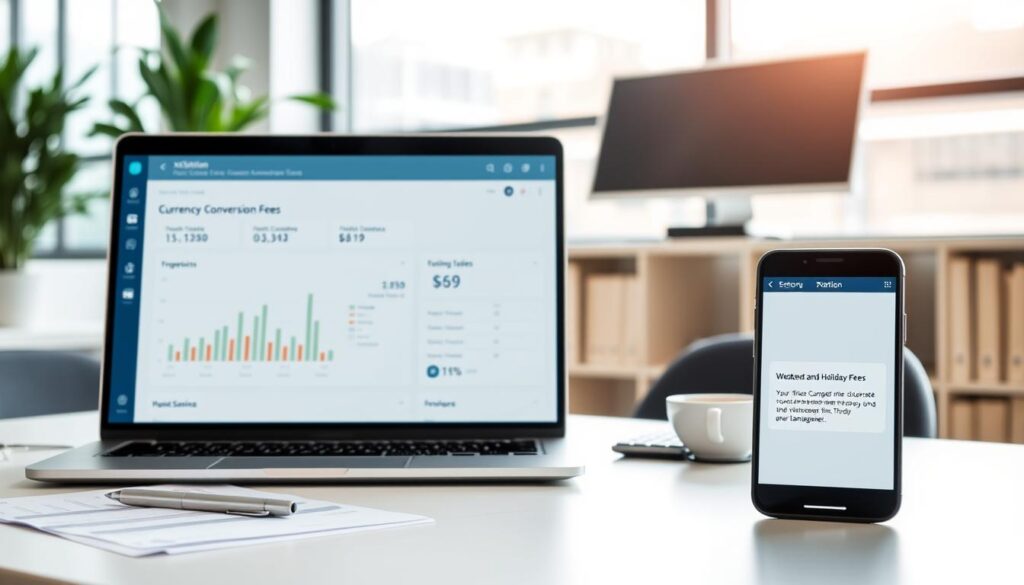
Effective fee management begins with mastering the tools available on your trading platform. The xStation 5 desktop application and mobile app provide comprehensive features for monitoring expenses. These tools help investors maintain control over their total trading costs.
Both versions offer real-time portfolio tracking and detailed transaction histories. Users can see exactly how much they’re paying in various charges. This transparency supports better financial decision-making.
Key Features for Monitoring Trading Costs
The built-in calculator stands out as particularly valuable for planning. It allows users to estimate fees before executing any trades. This helps compare costs across different instruments and timing scenarios.
Real-time spread displays show current market conditions clearly. Tighter spreads appear during high-liquidity periods, while wider spreads show during weekends. The economic calendar integration helps avoid holiday premium charges.
Customizable watchlists enable side-by-side comparison of home-currency and foreign instruments. Platform notifications alert users to completed transactions and associated fees. These features work seamlessly across both desktop and mobile versions.
The demo account feature provides risk-free practice with virtual money. Beginners can learn platform navigation and fee calculation without financial exposure. This builds confidence before transitioning to live trading.
Mobile app simplicity benefits long-term investors making straightforward stock and ETF purchases. The streamlined interface removes complexity while maintaining essential fee visibility. Each platform version serves different investor needs effectively.
Analyzing Additional Costs and Hidden Fees
Smart investors look beyond trading commissions to understand all potential expenses. Maintaining an investment account involves various operational costs that impact overall returns.
Withdrawal fees follow a tiered structure. Requests above €100 process free of charge. Smaller withdrawal amounts under €100 incur a €10 processing fee.
Funding your account also involves cost considerations. Bank transfers and PayPal deposits remain completely free. Card payments carry a 0.7% charge for EUR deposits or 0.95% for USD transactions.
The platform protects long-term investors through reasonable inactivity policies. Accounts face no charges for twelve months without trading activity. Investors holding physical assets avoid inactivity fees indefinitely.
Key features for cost-conscious traders include:
- Free transfers between same-currency sub-accounts
- No minimum deposit requirements during registration
- €25 per position charge for portfolio transfers
- Investor responsibility for tax reporting in most jurisdictions
Understanding these additional expenses helps traders calculate true investment costs. Strategic planning minimizes unnecessary charges while maintaining portfolio flexibility.
Ensuring Regulatory Safety and Tax Compliance with XTB

Investor security extends beyond market analysis to include regulatory oversight and tax responsibilities. This broker operates under the supervision of multiple top-tier European authorities.
These include the UK’s Financial Conduct Authority (FCA) and Poland’s Komisja Nadzoru Finansowego (KNF). This multi-jurisdictional framework ensures strict adherence to operational and financial standards.
A fundamental protection for client assets is fund segregation. Customer money is held separately from the broker’s operating capital. This safeguards trader funds even if the company faces financial difficulties.
An investor compensation scheme provides an additional layer of security. Eligible traders are protected up to €20,000 in the unlikely event of insolvency.
Being publicly listed on the Warsaw Stock Exchange adds a level of transparency. XTB is subject to regular financial disclosures and shareholder oversight.
For UK-based clients, the FCA’s robust regulatory framework applies. This offers strong consumer protections within the local market.
Tax compliance, however, remains the sole responsibility of the individual traders. The platform provides detailed annual statements for positions, transactions, and income.
These documents assist with tax preparation, but XTB does not withhold or remit taxes on behalf of clients. Italian investors, for example, must self-report capital gains and dividends.
They are also responsible for paying the IVAFE wealth tax on their account values. Understanding this structure helps traders assess the safety of their assets.
Consulting a local tax professional is highly recommended to ensure full compliance. Proper reporting avoids potential penalties for unreported foreign accounts.
Risk Management: Mitigating Fees in Volatile Markets
Market turbulence presents unique challenges for cost-conscious investors. Volatile periods often bring wider spreads and higher implicit costs. This makes fee management critical when trading during stressful market conditions.
Leverage amplifies both returns and losses but doesn’t reduce fees. These charges apply to the full position value rather than just the margin. This magnification effect becomes particularly important during rapid price movements.
Disciplined position management becomes essential for cost control. Setting predetermined entry and exit points reduces impulsive adjustments. This approach helps avoid accumulating unnecessary fees on cross-currency positions.
The 1:30 maximum leverage for EU retail traders provides important protection. Negative balance protection ensures traders cannot lose more than their deposited capital. These safeguards help manage risk during extreme market movements.
Conservative position sizing accounts for all fees and potential price swings. This strategy helps traders survive volatile periods. Maintaining capital for future opportunities requires careful risk assessment of all assets.
Understanding these dynamics is especially important for CFDs and leveraged trading. Proper fee calculation should include all costs before entering positions. This comprehensive approach protects investor assets during uncertain times.
Best Practices for Monitoring and Calculating Your Fees

Successful trading requires meticulous attention to expense tracking and calculation methods. Maintaining detailed records of all transactions provides the foundation for understanding true investment performance.
Traders should regularly monitor their monthly trading volume. This helps them understand their proximity to the €100,000 threshold where commission structures change.
Calculating the effective fee rate across all transactions offers valuable insights. This metric divides total fees by total transaction value to show cost efficiency.
The platform offers different account types with distinct pricing models. Comparing Standard and Pro accounts helps high-volume users minimize expenses based on their patterns.
Quarterly fee reviews identify cost trends and optimization opportunities. This regular analysis can reveal whether shifting to same-currency instruments would be beneficial.
Professional traders often target keeping total fees below 0.5% of annual portfolio value. This benchmark helps evaluate whether current trading patterns remain cost-effective over time.
Strategies for Passive Investors to Offset Conversion Costs
Passive investment strategies offer effective methods for reducing transaction-related costs. Long-term investors can build substantial wealth while minimizing expenses through careful planning.
Focusing on home-currency denominated etfs eliminates conversion charges entirely. European investors can access thousands of EUR-denominated funds tracking global markets. This approach provides international diversification without additional fees.
The platform provides fractional share investing starting from just €10. This allows efficient deployment across multiple instruments. Small regular contributions build diversified positions over time.
Automated Investment Plans enable systematic portfolio construction. Investors can set up monthly contributions starting from €15. These plans distribute amounts across up to nine different etfs.
Accumulating funds reinvest dividends automatically, enhancing tax efficiency. This eliminates the need for frequent dividend reinvestment transactions. The commission-free structure benefits regular contributors.
Buy-and-hold strategies minimize transaction frequency significantly. Traders only face potential charges when initially purchasing foreign stocks. Long holding periods make one-time costs less impactful.
Rebalancing through new contributions maintains target allocations. This approach avoids selling existing positions and incurring additional fees. The extensive selection of EUR-denominated etfs supports complete portfolio construction.
When evaluating etfs, investors should prioritize low expense ratios. These ongoing costs typically outweigh one-time transaction charges over decades. Proper account setup and instrument selection create efficient long-term investing pathways.
Wrapping Up Your XTB Trading Journey with Key Insights
Successful investing with any platform hinges on understanding costs and making strategic choices. This broker serves a diverse clientele, from passive investors to active traders.
For those who want to trade international markets, knowing the weekend fee premium is crucial. Aligning your account currency with your primary investments minimizes these costs effectively.
The commission-free structure for smaller volumes makes XTB attractive for building wealth. Using same-currency stocks and ETFs whenever possible preserves returns.
While powerful CFD trading with leverage is available, beginners should master physical assets first. The platform’s educational tools support informed decisions.
Ultimately, cost awareness separates successful traders from the rest. Whether you want to trade simple stocks or complex instruments, XTB provides the foundation for long-term growth.