Zero Spread Account Explained: How Brokers Really Price Your Trades
In the dynamic world of Forex trading, understanding how brokers price trades is crucial for success. This guide offers a clear overview of zero spread accounts, which have become increasingly popular among traders. By eliminating the traditional bid-ask spread, these accounts allow participants to enter and exit trades at the same price, enhancing overall efficiency.
Many professional traders favor zero spread options due to their transparency in costs. Without the typical spreads, the total cost of trading decreases, making it vital for long-term profitability. Additionally, liquidity providers play a significant role in ensuring that trades are executed swiftly and accurately.
Our analysis delves into how these accounts operate, the impact of commissions, and why they are gaining traction in the industry. Each pip saved contributes to a more robust trading performance, particularly for active market participants in the United Kingdom.
Understanding Zero Spread Trading and Its Mechanics
Understanding the pricing strategies of brokers is vital for traders in the Forex market. A zero spread account offers a unique approach to trading by providing direct access to raw market prices. This model allows traders to engage in transactions without the typical bid-ask spread, which can often eat into profits.
Here are some key concepts associated with zero spread trading:
- Direct Market Access: Traders can access prices starting from 0.0 pips on platforms like MetaTrader 5.
- ECN Technology: This connects traders directly to interbank liquidity providers, ensuring optimal execution.
- Liquidity Aggregation: It involves collecting the best bid-ask prices from multiple banks for competitive pricing.
- Fixed Commissions: Instead of a spread, brokers charge a fixed commission per trade, promoting transparency.
- Scalping Benefits: Scalpers favor this model as it minimizes the difference between buy and sell prices.
In essence, these accounts allow traders to pay for precision rather than hidden costs. This structure fosters a fair trading environment, especially for high-frequency participants.
Zero Spread Account Explained: The Commission-Based Model

In Forex trading, the transition from traditional spreads to a commission-based model can reshape how traders approach costs. This shift allows for greater clarity in understanding the expenses associated with each trade.
When a broker charges a standard commission of $7 per round turn for a lot of 100,000 units, traders can easily convert this into a pip-equivalent. This predictability in costs is invaluable for managing risk and reward ratios effectively.
From Spreads to Commissions
By adopting a fixed commission per trade, traders can avoid the unpredictability of spreads, especially during high-impact news events. This model provides a consistent revenue stream for brokers without the need to manipulate bid-ask prices.
Predictability in Trade Costs
Knowing the exact cost of each trade enables traders to refine their strategies. This approach is particularly beneficial for those trading large volumes, as the commission remains stable regardless of market fluctuations.
Cost Structure and Revenue Models in Zero Spread Trading

Navigating the intricate world of Forex trading requires insight into how brokers generate their revenue. Understanding these cost structures is vital for traders aiming to maximize their profitability.
Brokers utilize various revenue streams to sustain their operations:
- Fixed Commissions: A standard charge per trade helps maintain transparency.
- Rebates from Liquidity Providers: Major institutions like JP Morgan and Citibank offer rebates that contribute to broker income.
- Markup on Swap Rates: Some brokers apply a markup on overnight positions to ensure profitability.
- Account Maintenance Fees: Fees may be charged for maintaining zero spread accounts.
- Partnerships with Financial Institutions: Collaborations with banks ensure necessary market liquidity.
By diversifying their income, brokers can offer a zero spread model while covering operational costs. Traders should be cautious, as some brokers may impose hidden markups on exotic currency pairs. Understanding these models aids traders in selecting brokers that provide competitive and transparent pricing.
Advantages for Scalpers, Day Traders, and High-Frequency Traders

For active traders, the choice of trading account can significantly influence their success. Zero spread accounts offer unique advantages tailored for scalpers, day traders, and high-frequency traders.
These accounts enhance trading efficiency in several ways:
- Precision for Scalping: Scalpers rely on the accuracy of zero spread accounts to capture small price movements without the burden of a wide spread.
- Reduced Transaction Costs: High-frequency traders benefit from lower costs, allowing them to execute numerous trades in a single session.
- Effective Day Trading Strategies: Day traders can implement strategies more effectively when entry and exit prices are not distorted by spreads.
- Lower Breakeven Points: These accounts provide a significant advantage by lowering the breakeven point for traders operating in fast-moving markets.
- Algorithmic Trading Support: The ability to execute trades with high precision is essential for algorithmic systems requiring consistent pricing data.
By eliminating the spread, traders effectively increase their potential profit margins on every trade. Many professional scalpers prefer these accounts for their superior execution speed and lower overall costs. Cumulatively, the savings from avoiding spreads can be substantial for high-volume traders active throughout the trading day.
Execution Strategies: Managing Slippage, Market Volatility, and Liquidity

Effective execution strategies are essential for navigating the complexities of Forex trading. Traders must be aware of how slippage can impact their trades, especially during high-impact news events. Slippage occurs when the order size exceeds the available liquidity at the top of the book, leading to execution at less favorable prices.
During periods of extreme market volatility, managing slippage becomes critical. Traders should understand that a zero spread does not equate to zero costs. High volatility can lead to execution at worse prices, which may erode potential profits.
To optimize order execution, it is advisable to avoid market orders during major news releases. Instead, using limit orders can help control entry prices. Brokers offering true ECN access provide a clearer view of market depth, allowing traders to anticipate potential slippage issues.
Moreover, every trader should develop a robust strategy for handling volatility. Monitoring market conditions closely is essential to navigate the risks associated with slippage effectively. By doing so, traders can ensure their trades are executed as intended, maintaining the integrity of their trading strategies.
Comparing Zero Spread and Standard Trading Accounts
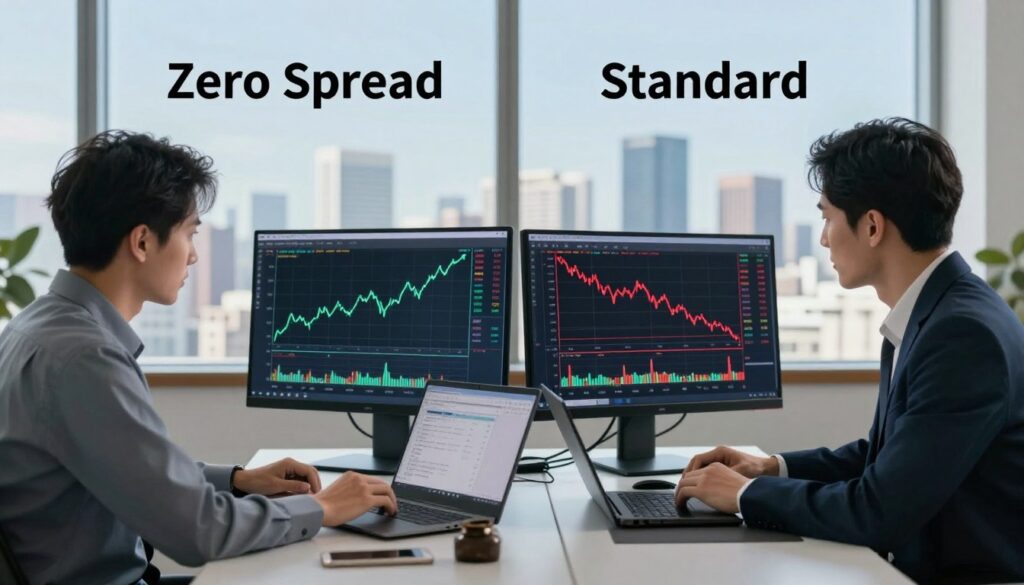
When choosing a trading account, understanding the differences between various models is essential for optimizing trading outcomes. A comparison between zero spread and standard trading accounts reveals key differences in transaction costs and their impact on trading efficiency.
For high-frequency traders, the zero spread model is often more cost-efficient. By eliminating the spread tax, traders can maximize their profits on each trade. However, long-term traders might find that a standard account, with its simpler structure, could be more economical if they do not trade frequently.
The difference in cost efficiency largely depends on individual trading styles, volume, and the currency pairs involved. While a standard account may appear easier to manage, the hidden costs associated with spreads can significantly diminish potential profits.
- Cost Transparency: Zero spread accounts provide clear pricing, allowing traders to account for commissions accurately.
- Discipline Required: Traders must manage their money effectively, considering commissions on every trade.
- Impact of Slippage: Evaluating total costs, including potential slippage during volatility, is crucial.
- Long-Term Goals: Conducting a cost analysis helps determine which account type aligns with financial objectives.
- Execution Needs: The choice should reflect trading frequency and the need for precise execution.
Final Thoughts on Maximizing Trading Efficiency
Maximizing profits hinges on a trader’s awareness of transaction costs and execution. Transitioning to models that emphasize transparency and lower costs is crucial for traders.
Choosing a zero spread account aligns interests with brokers who prioritize precision in execution. Every pip saved contributes directly to profitability, especially in competitive Forex markets.
Understanding slippage and the true costs of trades is vital for long-term success. Whether one is a scalper or a day trader, the right account structure can lead to consistent growth.
Evaluate current trading costs and consider if a commission-based model could enhance overall performance. The tools and strategies employed define a trader’s journey toward professionalism.
Related Articles
Read Also